
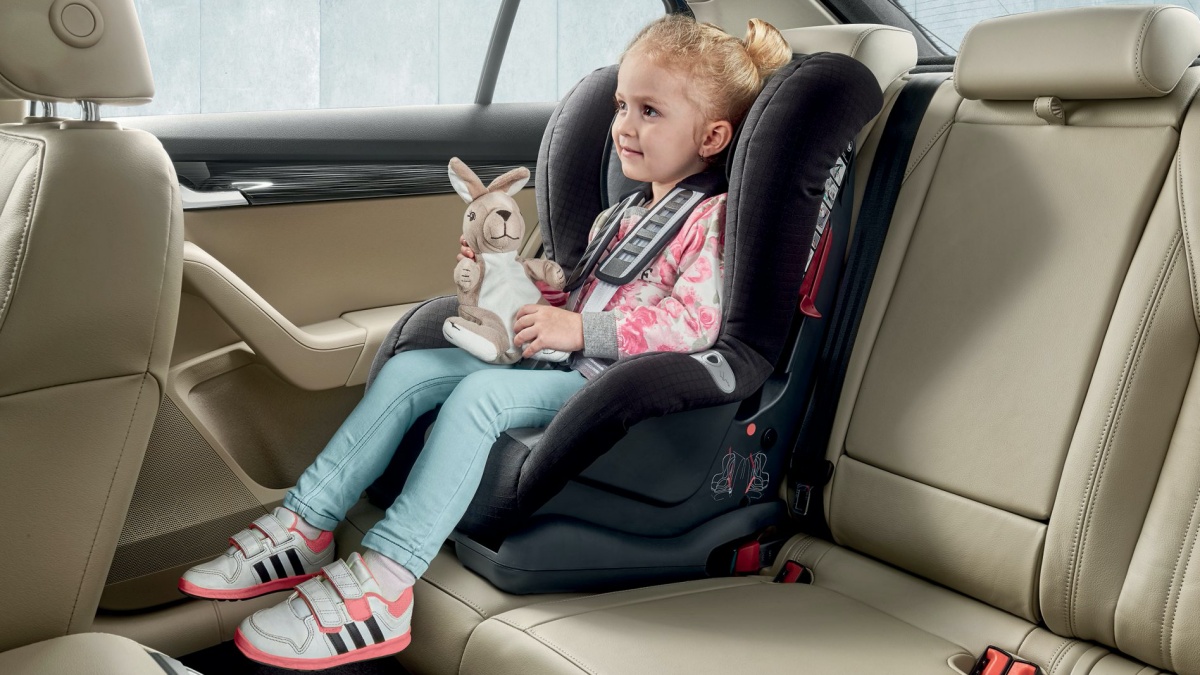
With their generous interiors and superb versatility, SKODA vehicles are popular cars for families with children.
When travelling with youngsters, however, these young passengers must be secured in suitable and approved child seats before every journey to provide maximum protection in the event of an accident. The safest place for children is on the rear seat, but solutions for the front passenger seat are also available. The ŠKODA Genuine Accessories range offers suitable child seats for any age.
Children travelling in a car require a particularly high level of protection. Their muscles and bones are still growing and are not yet as strong and resilient as those of an adult. It is therefore vitally important to diligently secure young passengers prior to every journey in a car. Youngsters up to a height of 1.50 m and weighing up to 36 kg must generally sit in a dedicated child seat. However, legal requirements vary from country to country. All child seats from the ŠKODA Genuine Accessories range comply with the current ECE standard and have passed a number of stringent tests such as the Euro NCAP crash tests as well as a fire safety test.
As a rule, children are safest when travelling on the rear seat and ideally on the side closest to the pavement, as that poses fewer risks when entering and exiting the car as well as during the process of securing a child in their seat. Smaller children are also allowed to travel on the front passenger seat in a backwards-facing child seat, provided the respective air bag has been deactivated. A front‑facing seat may also be used, as long as it has been officially approved for use in this position. The relevant information can be found in the child seat manual or the vehicle handbook. Alternatively, a dealer will be able to provide advice. Before buying a child seat, it is important to check the fit of the seat in the relevant car as this makes it possible to identify whether a belt might be too short or the seat too large.
A child seat can be attached using either the car’s three-point seat belt or an ISOFIX system. The latter consists of two connectors on the child seat which snap into two ISOFIX slots, situated between the seat cushion and the backrest, that are firmly attached to the vehicle body. This rigid connection increases safety, and the system’s ease of use reduces the risk of human error. To ensure the child seat remains in position, this system requires a third anchor point, usually in the footwell in front of the seats, to complement the ISOFIX connectors. At ŠKODA, the outer rear seats in all current models feature special top tether eyelets as this third anchor point. The ŠKODA SCALA and KAMIQ also offer an ISOFIX system with top tether anchor points included as standard for the front passenger seat.
Group 0 and 0+ seats: ŠKODA BABY-SAFE Plus
Child seats are subdivided into five different categories. Group 0 and 0+ seats are suitable for newborns and babies weighing up to around 13 kg. These baby carriers are exclusively rear-facing. This ensures that an infant’s back and neck suffer less strain in the event of an emergency stop. The child is first strapped into the carrier, which is then placed on the car seat and secured using the seat belt. The belt has to be routed through the openings provided and clicked into its catch. After that, the belt is positioned along the guides behind the seat and pulled tight. The baby carrier’s handle is fixed in the travel position. A final check consisting of a vigorous tug should then be performed to ensure that the seat belt is tight enough and positioned correctly. Alternatively, a group 0 or 0+ seat can be attached to a previously installed ISOFIX base. The ŠKODA BABY‑SAFE Plus comes with an ISOFIX base included.
Group 1 seats: ŠKODA ISOFIX DUO plus top tether
Group 1 consists of seats for children aged nine months to four years. These seats usually face forwards and provide excellent protection in the event of an accident. If a collision occurs, they absorb energy and keep delicate areas such as the head and neck particularly safe. They also shield the child from any items that may become airborne during a crash. When choosing a seat, size is a key factor, as only an appropriately sized seat provides the necessary comfort. Installing this type of seat also starts with clicking the seats’ prongs into the corresponding ISOFIX slots. The top tether connector is attached to the anchor point at the back of the seat’s backrest. The child is then strapped in using the child seat’s five-point seat belt. For safety reasons, children should not be wearing bulky items of clothing such as thick winter jackets; such items can however be placed over the belt. This ensures the belt is close enough to the child’s body to provide immediate restraint in the event of an emergency stop. ŠKODA is offering the ISOFIX DUO plus top tether seat for this group.
Group 2 and 3 seats: ŠKODA Kidfix XP and ŠKODA Kidfix XP II
Seats in groups 2 and 3 are designed for children aged four and over, and weighing up to 36 kg. This group includes booster seats, but seats with a backrest and side bolsters such as the ŠKODA Kidfix XP and the ŠKODA Kidfix XP II are far more effective at protecting children from serious injury if the car is involved in an accident. This applies especially to the head and neck area. The child seat is placed on the seat pad and strapped in along with the child. Alternatively, additional ISOFIX attachment is possible as well. When selecting a seat, the child’s comfort during the journey itself and when entering and exiting the car should be taken into consideration.
